
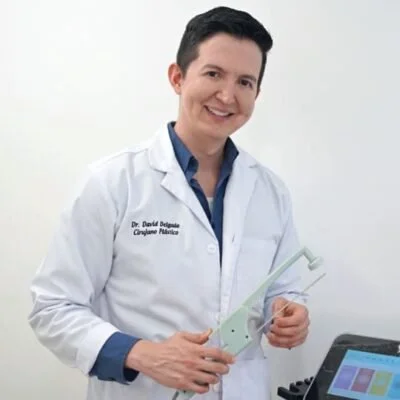
Dr. David Delgado
Plastic Surgeon · Medical Director, Dharma Hair
Member of the Colombian Society of Plastic Surgery (SCCP) · +10 years of experience
Published: agosto 26, 2026 · Updated: agosto 31, 2026
If you are over 30 and have started noticing a receding hairline, deeper temples, thinning at the crown, or areas where your scalp is becoming increasingly visible, you have probably searched for the best hair loss treatment for male pattern hair loss. The answer depends on how much hair you have already lost, whether the loss is still progressing, and—most importantly—whether you have a healthy donor area.
At Dharma Hair, we evaluate hair loss from a medical and surgical perspective. Medications and non-surgical therapies can be valuable for preserving existing hair, but when follicles have already been lost and a patient has an adequate donor area, a hair transplant offers something other treatments cannot: the possibility of physically restoring hair to areas that have become bald or significantly depleted.
RESTORE YOUR HAIR and your confidence
Schedule an assessment with our medical team and discover the hair restoration plan designed for your case: precise, safe, and natural-looking results.
Why Does Male Hair Loss Usually Become More Noticeable After 30?
The most common cause of progressive hair loss in men is androgenetic alopecia, commonly known as male pattern hair loss.
It typically affects the frontal hairline, temples, mid-scalp, and crown. The condition is associated with the progressive miniaturization of genetically susceptible hair follicles under the influence of androgens, particularly dihydrotestosterone or DHT. Over time, affected hairs become thinner, shorter, and less visible. (Devjani et al., 2023). View source
This distinction is important because a weak follicle and an absent follicle are not the same problem.
If follicles are still present but becoming thinner, medical therapy may help preserve or strengthen them. If an area has already experienced significant follicular loss, however, medications cannot simply create a new supply of donor follicles in that area.
That is where hair transplantation becomes especially relevant.
What Are the Main Hair Loss Treatments for Men?
There is no single treatment that should automatically be prescribed to every man experiencing hair loss. At Dharma Hair, we first evaluate the pattern of alopecia, progression, donor density, hair characteristics, age, medical history, and expectations.
For men over 30 with established male pattern hair loss, the main options generally include:
| Treatment | Main objective | Can it restore hair to a bald area? | Ongoing treatment? |
|---|---|---|---|
| Minoxidil | Support growth and preserve existing hair | Limited when follicles have already been lost | Usually yes |
| Finasteride | Reduce progression of androgenetic hair loss | Does not physically replace lost follicles | Usually yes |
| PRP | Support existing follicles in selected patients | Not equivalent to transplantation | Maintenance commonly required |
| Low-level light therapy | Support hair growth in selected patients | Limited for established bald areas | Consistency required |
| Hair transplant | Move healthy follicles into areas affected by hair loss | Yes | Transplanted hair does not require continuous treatment, although native hair may still require medical management. |
Treatment suitability depends on the type and progression of hair loss, donor area characteristics and individual medical assessment.
Minoxidil: Useful for Existing Hair, but It Has Limits
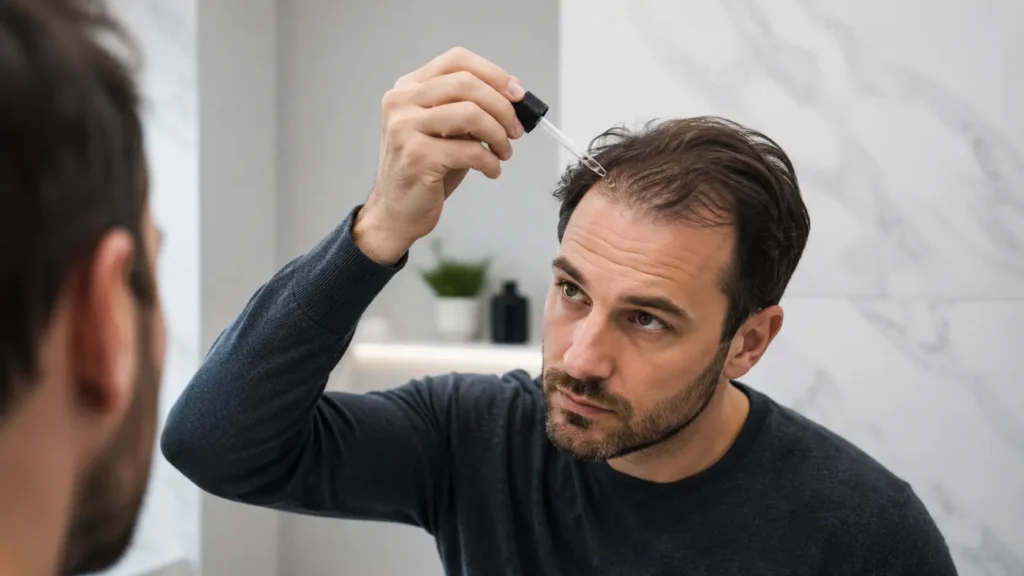
Minoxidil is one of the best-known treatments for male pattern hair loss.
It can be particularly useful when follicles are still present and undergoing miniaturization. In selected patients, it may help stimulate growth, maintain density, and slow the visual progression of thinning.
However, there is an important limitation: minoxidil does not move new follicles into an area where significant hair loss has already occurred.
Results also depend on continued use. According to the American Academy of Dermatology, when minoxidil is discontinued, its benefits are gradually lost. (American Academy of Dermatology Association, n.d.).
For a 35-, 40-, or 45-year-old man with clearly defined temples or a significantly depleted frontal area, this difference becomes especially relevant.
The question is no longer simply: How can we preserve the hair that remains?
It becomes: How can we restore hair where it has already been lost?
Finasteride: Important for Controlling Progression, but Not a Replacement for Surgery

Finasteride works differently from minoxidil.
It inhibits the conversion of testosterone into DHT, one of the hormones involved in follicular miniaturization in androgenetic alopecia. For this reason, it can be an important medical option for slowing progression in appropriately selected male patients. It is a prescription treatment and should be evaluated with a physician because potential adverse effects and individual contraindications must be considered. (Devjani et al., 2023).
But again, its purpose is different from that of a transplant.
Finasteride can help us protect susceptible existing hair. A hair transplant allows us to redistribute healthy follicular units into areas that need greater coverage.
In fact, these approaches do not necessarily compete with each other.
For some patients, the strongest long-term strategy can involve hair transplantation to restore the areas that have already lost significant density, combined with medical management to protect the native hair that remains.
PRP and Other Non-Surgical Treatments: Supportive Rather Than Reconstructive

PRP and other non-surgical therapies can also have a role in hair restoration plans.
PRP uses a concentration of the patient’s own platelets and growth factors and may be recommended to support hair growth in selected patients. Low-level light therapy is another non-surgical alternative used to stimulate follicles.
However, these treatments should not be confused with surgical restoration.
They work with the follicles that are already present. They do not redistribute follicular units from a healthy donor area into a bald frontal hairline or crown.
A comprehensive review of androgenetic alopecia treatments includes topical and oral medications, PRP, low-level light therapy, and hair transplantation among the available approaches, reinforcing an important principle: different therapies solve different stages and characteristics of hair loss. (Devjani et al., 2023).
Why We Consider Hair Transplantation the Best Option for the Right Candidate
For a man over 30 with established hair loss and a healthy donor area, hair transplantation offers a fundamental advantage over non-surgical treatments.
It does not simply attempt to stimulate thinning hair. It moves existing healthy follicles to the areas where greater coverage is needed.
Follicular units are typically obtained from areas of the scalp that are more resistant to the androgen-related miniaturization responsible for male pattern baldness and are redistributed according to an individualized surgical design.
Modern hair transplantation can be performed with Follicular Unit Extraction (FUE), where individual follicular units are removed from the donor area rather than excising a linear strip of scalp. Medical literature recognizes patients with sufficient donor hair and an appropriate pattern of hair loss as suitable candidates for transplantation. (Devjani et al., 2023).
View source →Having a Good Donor Area Is Essential
Not every man with hair loss is automatically a good candidate for transplantation.
The donor area is one of the most valuable resources in hair restoration surgery because its supply is finite.
Before recommending surgery, we need to determine whether there are enough healthy follicular units to create a meaningful improvement without excessively depleting the donor region.
At Dharma Hair, our assessment considers factors such as:
- Donor density
- Hair shaft thickness
- Follicular distribution
- Degree and pattern of hair loss
- Stability or progression of alopecia
- Size of the recipient area
- Desired hairline
- Potential future hair loss
- Realistic density expectations
This is also why we do not believe that “more grafts always means a better transplant.”
The objective is to use the donor area intelligently, protect it, and strategically place follicles where they can create the greatest visual impact.
Manual FUE or ARTAS iX Robotic Hair Transplantation?
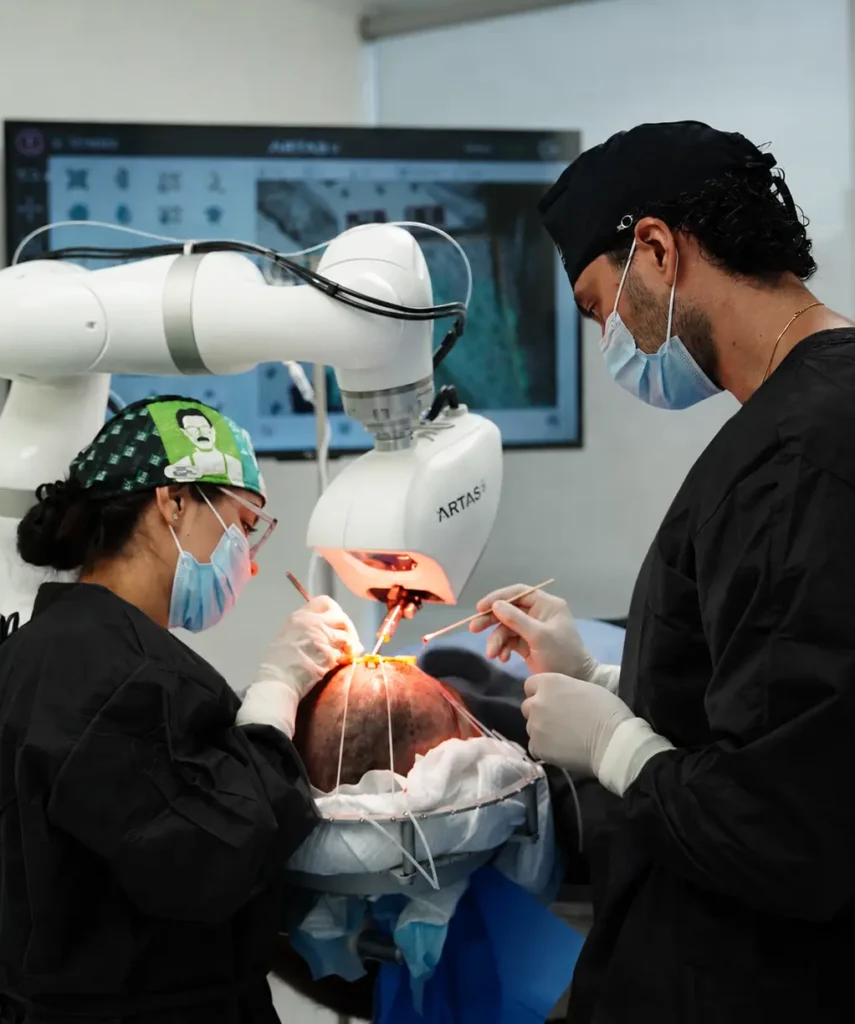
At Dharma Hair in Medellín, we evaluate both manual FUE and robotic-assisted FUE with ARTAS iX. Both techniques extract follicular units individually; the main difference is how the extraction process is performed.
With ARTAS iX, robotic imaging and algorithms assist our medical team in analyzing and selecting follicles according to the surgical plan. The physician remains responsible for the key decisions, including donor management, hairline design, and the overall strategy.
So the real question is not simply “Which technique is better?” but “Which approach is best for your donor area, hair loss pattern, and long-term goals?”
That answer begins with a medical assessment.

So, What Is the Best Hair Loss Treatment for Male Pattern Hair Loss?
A hair transplant can restore follicular coverage in areas where substantial hair loss has already occurred.
This is why, for the right candidate, we consider a hair transplant one of the strongest long-term solutions for male pattern hair loss. In some cases, it does not replace medical treatment; it complements it.
At Dharma Hair, we do not begin by deciding how many grafts we want to extract.
We begin by understanding what your hair could look like in the long term.
We evaluate your donor capacity, degree of hair loss, frontal design, facial proportions, hair characteristics, and potential progression before recommending a surgical plan.
Depending on your case, we can consider manual FUE or robotic-assisted hair transplantation with ARTAS iX, always under medical planning and supervision.
If you are over 30, your temples continue to recede, your crown is becoming increasingly visible, or you already have areas where medical treatments alone are unlikely to provide the coverage you want, a hair transplant evaluation may be the next step.
Schedule your consultation with Dharma Hair in Medellín and find out whether your donor area makes you a good candidate for hair restoration.
Frequently Asked Questions
What is the best hair loss treatment for male pattern baldness?
It depends on the stage of hair loss. Men with early thinning may benefit from medical therapies such as minoxidil or finasteride. For men with established bald or significantly depleted areas and an adequate donor area, a hair transplant can offer a more complete restoration option because follicles are physically redistributed into the areas affected by hair loss.
Is a hair transplant better than minoxidil?
They perform different functions. Minoxidil can help support existing follicles and stimulate some hair growth, while a hair transplant moves healthy follicles into areas where greater coverage is required. When a frontal area is already significantly depleted, transplantation can address a limitation that minoxidil cannot.
Is a hair transplant better than finasteride?
Not necessarily in every situation. Finasteride can be highly valuable for slowing the progression of androgenetic alopecia in appropriate patients, while transplantation restores coverage to areas where hair has already been lost. Some patients may benefit from both approaches as part of the same long-term plan.
What age is best for a male hair transplant?
There is no universal ideal age. We focus more on the pattern and stability of hair loss, donor quality, future progression, and expectations. For men over 30, the evolution of androgenetic alopecia may be easier to assess than in very young patients, but every case must still be evaluated individually.
How do I know if I have a good donor area?
A good donor area generally has enough healthy follicular units, adequate density, appropriate hair characteristics, and limited miniaturization. During your assessment at Dharma Hair, we examine the donor area before determining how much coverage can realistically be created.
Can transplanted hair fall out again?
The hair shafts commonly shed temporarily after transplantation before new growth begins. The transplanted follicles are selected from donor areas that are generally more resistant to the androgen-related miniaturization responsible for male pattern hair loss. However, your non-transplanted native hair can continue to thin over time, which is why long-term planning is essential.
What is the difference between manual FUE and ARTAS iX?
Both use the FUE principle of individually extracting follicular units. In manual FUE, the extraction process is performed manually by the surgical team. With ARTAS iX, robotic imaging and algorithms assist in analyzing and selecting follicular units during parts of the procedure. At Dharma Hair, the physician determines which approach is most appropriate for each patient.
Can I get a hair transplant if I am still losing hair?
Possibly, but active progression must be considered carefully. In some patients, we may first recommend medical management to stabilize ongoing loss. A transplant restores selected areas but does not prevent untreated native follicles from continuing to miniaturize. The objective is therefore to design a strategy that considers both your current hair loss and its possible future evolution.
Dharma Hair — Specialized Hair Restoration
Torre Médica Oviedo, Cll 6 Sur #43A-227, Office 701, Medellín, Colombia
Phone/WhatsApp: +57 321 226 5964 · Email: clinicabedharma@gmail.com
Medical Director: Dr. David Delgado — Plastic Surgeon, SCCP Member


