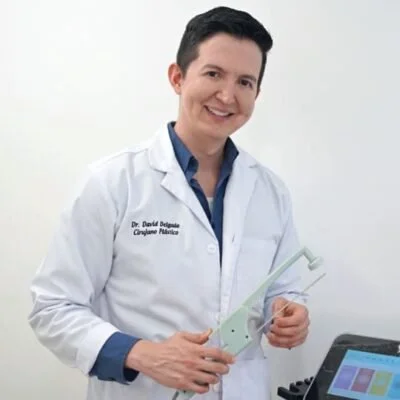
Dr. David Delgado
Plastic Surgeon · Medical Director, Dharma Hair
Member of the Colombian Society of Plastic Surgery (SCCP) · +10 years of experience
Published: octubre 1, 2026 · Updated: octubre 2, 2026
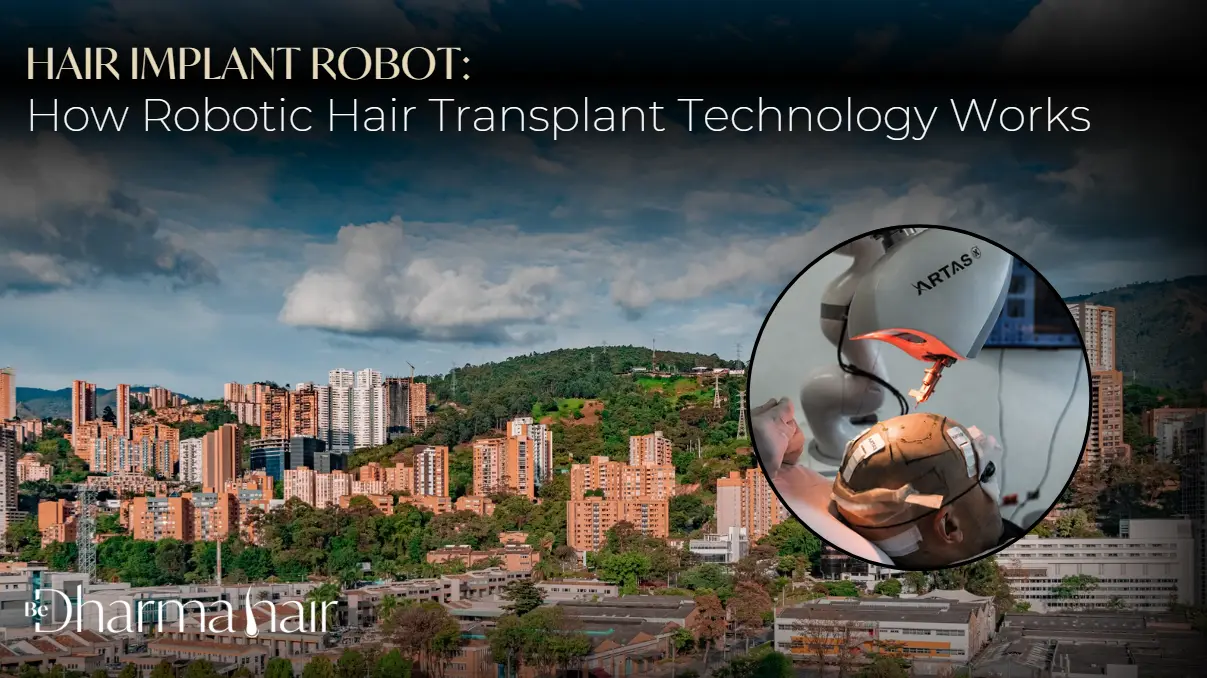
A hair implant robot may sound like a fully automated hair transplant, but that is not how modern robotic hair restoration works. At Dharma Hair, we use ARTAS iX as an advanced surgical-assistance system that helps us analyze the donor area, identify suitable follicular units and support precise extraction—while the physician remains responsible for the medical plan, hairline design and key clinical decisions.
In this guide, we will explain how a robotic hair transplant works, what ARTAS iX can do during the procedure, and where medical judgment remains essential. Our goal is to help you understand the technology behind robotic hair restoration before deciding whether it may be appropriate for your case.
Personalized Hair Evaluation
Discover if ARTAS iX is right for you
Schedule an evaluation with our medical team and discover a hair restoration plan designed around your goals, donor area and individual needs.
What Is a Hair Implant Robot and What Does It Actually Do?
A hair implant robot is not a machine that independently performs a hair transplant from start to finish. In our practice, we use robotic technology as a surgical-assistance system that adds real-time imaging, follicular analysis and controlled extraction to the procedure, while the medical team continues to direct the case.
Is a Robotic Hair Transplant Performed Entirely by a Robot?
No. A robotic hair transplant is a robot-assisted procedure, not an autonomous surgery.
With ARTAS iX, the system can analyze and track follicular units within a selected donor area and assist with extraction, but the physician remains in control of the surgical strategy. Our team determines how the procedure should be planned, which areas require treatment and how the available donor hair should be used.
This distinction is important: the robot supports precision; it does not replace medical judgment.
What Parts of the Hair Transplant Can Robotic Technology Assist?
During an ARTAS–assisted procedure, robotic technology can support several stages of follicular unit extraction:
| ARTAS iX can assist with | What this means in practice |
|---|---|
| Donor area analysis | The system maps selected areas of the donor region. |
| Follicular unit identification | Robotic vision evaluates visible characteristics such as hair angle, position and thickness. |
| Graft selection | The system helps identify follicular units according to parameters established for the case. |
| Follicular unit extraction | ARTAS assists in separating and extracting selected grafts using robotic FUE technology. |
| Procedure planning | The system provides visual and digital information that helps us manage extraction more systematically. |
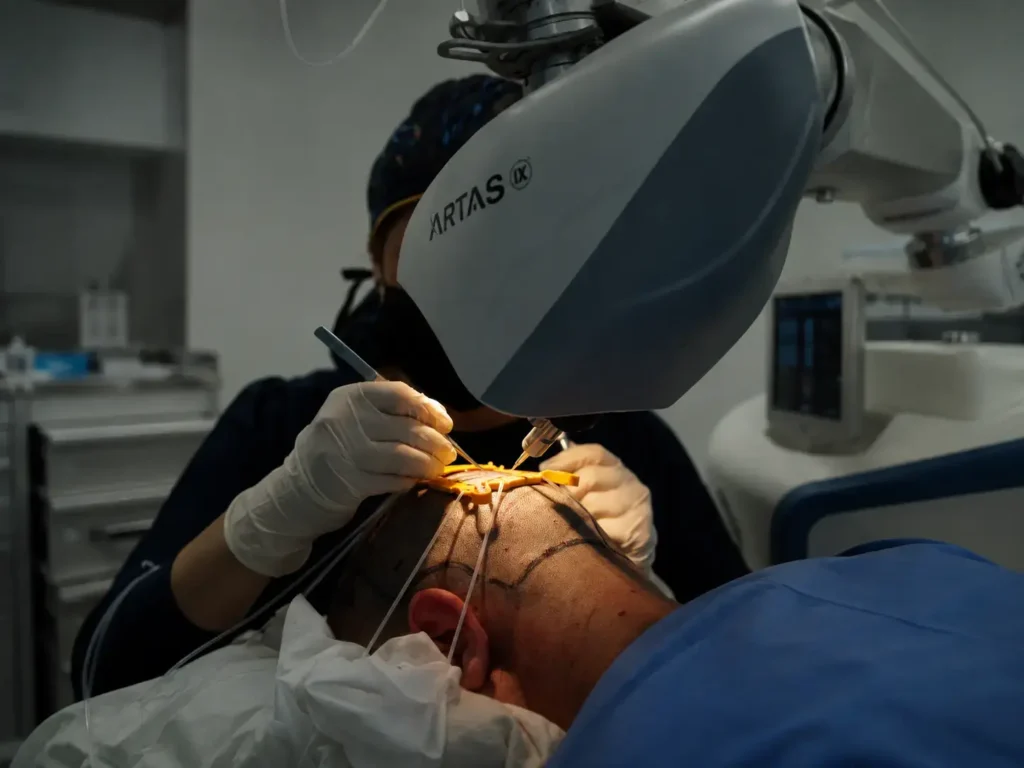
The ARTAS vision system works continuously during extraction. It analyzes characteristics such as hair height, angle and thickness and can stop an extraction movement if it loses visual reference or detects patient movement.
What Decisions Still Depend on the Hair Transplant Doctor?
Technology provides information and precision tools, but some of the most important decisions remain medical.
At Dharma Hair, we still determine:
- The diagnosis and whether a transplant is appropriate
- The hairline design and recipient-area strategy
- How many grafts should be harvested
- How those grafts should be distributed
- Which types of follicular units are most useful for specific areas
- Whether the extracted grafts are suitable to continue with the planned procedure
This last point is especially important. During the initial extraction, the physician reviews the first follicular units and evaluates the grafts before deciding whether to continue. The system cannot assess everything beneath the skin on its own, so the medical team must still inspect the extracted follicles and guide the next steps.
ARTAS iX helps us see, analyze and extract with greater technological control. The physician still decides how that technology should be used for each patient.
How Does the ARTAS iX Hair Implant Robot Work?
What makes ARTAS iX different from a conventional extraction device is that it does more than assist with the physical removal of grafts. It combines robotic vision, digital analysis and automated guidance to help us understand what is happening in the donor area before and during extraction.
How Robotic Vision Maps the Donor Area
Before extraction begins, we work within selected areas of the donor region rather than treating the entire scalp as one continuous field. ARTAS iX uses its imaging system to map those areas and identify the follicular units available within them.
This allows us to follow the donor area in a more structured way and helps the system maintain a visual reference for the follicles it is analyzing throughout the procedure.
How ARTAS iX Analyzes Hair Angle, Thickness and Follicular Units
Hair does not emerge from the scalp at the same angle or with the same thickness in every area. ARTAS iX evaluates visible characteristics such as:
- Hair angle and direction
- Hair thickness
- The position of individual follicular units
- The relationship between nearby follicles
This information helps guide the robotic system toward the follicular units that match the parameters established for the procedure.
How Artificial Intelligence and Algorithms Assist Graft Selection
The intelligence behind a hair implant robot lies in its ability to process visual information repeatedly and apply predefined parameters to follicular-unit selection.
We can use those parameters to support the surgical plan. For example, certain areas of a transplant may require different types of grafts depending on the density, transition and natural appearance we want to create.
The algorithm helps us identify suitable options, but it does not independently decide what the final hairline should look like or how the grafts should be distributed. Those remain medical and aesthetic decisions.
How Real-Time Tracking Helps Guide Follicular Unit Extraction
One of the most relevant functions of ARTAS iX is continuous visual tracking.
During extraction, the system repeatedly updates the position of the targeted hair. If the visual reference is lost or the patient moves in a way that changes the target, the system is designed to avoid proceeding blindly.
In practical terms, this gives us another layer of control during a highly repetitive and technically demanding part of robotic FUE.
What Happens During an ARTAS Robotic Hair Transplant?
For the patient, an ARTAS procedure is still a carefully planned hair transplant—not a technology demonstration. The robot becomes useful only after we have established what needs to be treated, what donor resources are available and how those follicles should be used.
| Step | What Happens During the Procedure |
|---|---|
| Step 1 Medical Evaluation and Hairline Planning | We begin by evaluating the pattern and progression of hair loss, the quality of the donor area and the patient's expectations. From there, we determine whether surgery is appropriate and develop a plan for the recipient area. This includes hairline design, the areas that require greater coverage and the number of grafts that may reasonably be used. |
| Step 2 Donor Area Mapping with the Hair Implant Robot | The donor area is prepared and divided into working zones. ARTAS iX then analyzes the selected region so the extraction can be distributed across the donor area instead of being concentrated indiscriminately in one location. |
| Step 3 Identification and Selection of Follicular Units | Once the donor area has been mapped, ARTAS begins identifying follicular units according to the parameters defined for the case. The important point is that the machine does not create surgical strategy. We establish the criteria; technology helps execute them. |
| Step 4 Robotic Follicular Unit Extraction | During robotic FUE, ARTAS aligns its extraction mechanism with the selected follicular unit and assists in separating it from the surrounding tissue. The goal is to isolate individual follicular units through small circular openings rather than removing a strip of scalp. This is the same fundamental FUE principle used in manual extraction, but here part of the process is guided by robotic imaging and automated positioning. |
| Step 5 Graft Evaluation by the Medical Team | Extraction is not the end of the process. Our team evaluates the harvested grafts because the robot's cameras analyze what is visible at the surface, while the characteristics of the follicular unit beneath the skin can only be fully appreciated once the graft has been removed. We assess the quality of the units obtained and use that information to determine how the extraction should continue. |
| Step 6 Recipient Area Planning and Hair Implantation | A natural result depends on much more than obtaining healthy grafts. We must decide where each graft should go, how the density should transition between areas, and what direction and distribution will create a result that looks appropriate for that patient's face and existing hair. ARTAS iX can assist different stages of the procedure, but hairline design, recipient-site strategy and the final aesthetic plan remain under medical supervision. |
What Are the Benefits of Using a Hair Implant Robot?
The potential value of robotic assistance is not that it guarantees a particular result. Its role is to give us additional tools for analyzing and controlling some of the most repetitive and technically sensitive stages of FUE.
More Controlled Follicular Unit Selection
With digital analysis, ARTAS can help us select follicular units according to parameters established before and during the procedure. That can be particularly useful when we want to manage different graft types strategically rather than approaching the donor area as if every follicular unit were interchangeable.
Consistency During Robotic FUE Extraction
Extracting hundreds or thousands of follicular units requires repeated alignment and positioning. Robotic assistance can maintain the same analytical process throughout that repetitive stage, which may help reduce variability associated with performing the same manual movement over an extended period.
Better Control of Donor Area Distribution
A good transplant is not defined by extracting the highest possible number of grafts. We also need to protect the appearance and long-term usefulness of the donor area. ARTAS helps us work within mapped zones and distribute extraction according to the surgical plan rather than overharvesting one concentrated region. This matters because the donor area is a limited resource.
Technology-Assisted Precision Without Replacing Medical Judgment
For us, this is the most important benefit to understanding. ARTAS iX adds technological precision to a medical procedure; it does not replace the people responsible for that procedure.
The strongest use of robotic technology comes from combining digital analysis and consistent execution with appropriate patient selection, thoughtful planning and an experienced hair restoration team.
Robotic FUE vs. Manual FUE: What Is the Difference?
The difference between robotic FUE and manual FUE is not that they are completely different transplant techniques. Both are based on the same fundamental principle: follicular units are individually isolated from the donor area rather than removing a strip of scalp.
The main difference is how part of that extraction process is performed and guided. Modern reviews of FUE technology describe manual, motorized and robotic systems as different ways of carrying out follicular unit excision.
How Follicles Are Identified in Robotic FUE and Manual FUE
In manual FUE, the physician or trained specialist visually identifies the follicular units and aligns the extraction instrument according to hair direction, angle and scalp characteristics.
With ARTAS robotic FUE, cameras and software assist with that analysis. The system processes visual information from the donor area and uses programmed parameters to guide the selection and positioning of the robotic extraction mechanism.
This does not eliminate physician involvement. It changes the tools available to the physician during extraction.
How Follicular Units Are Extracted
In both approaches, a small punch is used to isolate follicular units from the surrounding tissue.
With manual FUE, the specialist controls the punch directly and guides the extraction movement according to the characteristics of each follicular unit.
With ARTAS, part of the alignment and extraction movement is performed by the robotic system according to parameters that can be adjusted by the medical team.
This is why we prefer to describe ARTAS as robot-assisted FUE, rather than as a separate method of hair transplantation.
Does a Hair Implant Robot Guarantee Better Results?
No technology can guarantee a superior hair transplant result by itself.
A recent comparative study evaluated ARTAS-assisted harvesting and conventional FUE in 13 men with androgenetic alopecia. It found no significant difference in overall patient satisfaction at follow-up. The transection rate was comparable between the two methods. Fue showed a higher overall yield rate (90,03% vs. 82,05%) and a lower discard rate (5.46% vs. 10,71%) in this study. The authors also highlighted the small sample size and the need for further research.
The device is only one variable in the outcome. Results are also influenced by donor quality, diagnosis, graft handling, hairline design, graft distribution, recipient-site planning and postoperative care.
Why the Experience of the Hair Restoration Team Still Matters
Technology can improve the way information is collected and how repetitive movements are executed, but hair restoration still requires judgment.
We need to determine which follicles should be used, how much of the donor area can safely be harvested and where those grafts will create the greatest visual benefit.
That is why we do not see manual FUE and robotic FUE as a competition between a doctor and a machine. We see them as different ways of performing FUE, each requiring proper indication and an experienced team to use the technique appropriately.
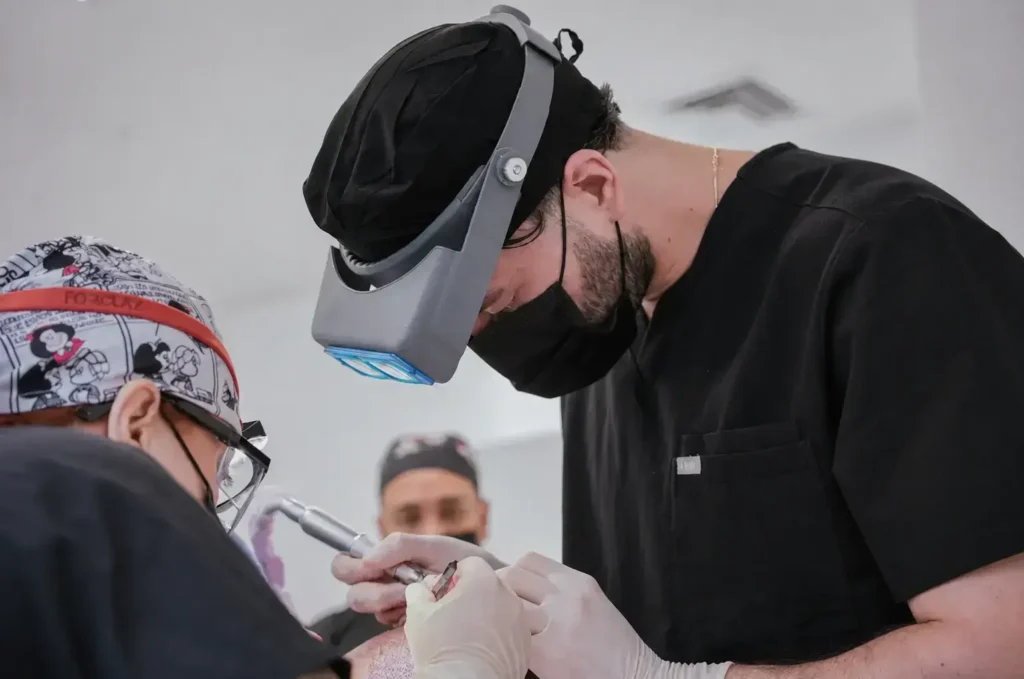
Choose Dharma Hair for an ARTAS Robotic Hair Transplant in Medellín, Colombia
At Dharma Hair, we combine ARTAS iX robotic hair restoration technology with careful medical planning to create a treatment strategy that is tailored to each patient. From the initial diagnosis and donor-area evaluation to hairline design and graft distribution, our team remains involved in every important decision. Technology helps us work with greater control and consistency, but the procedure is always guided by medical judgment and by what is appropriate for your specific pattern of hair loss.
We are in Torre Médica Oviedo in Medellín, where we also welcome international patients looking for an advanced robotic hair transplant in Colombia. Before you travel, we can begin with a virtual evaluation to review your case, discuss your goals and plan the next steps in advance. If you are considering an ARTAS iX hair transplant, our team is here to guide you through the process with clear information, realistic expectations and close medical support from your first consultation onward.
Frequently Asked Questions About Hair Implant Robots
1. What is a hair implant robot?
A hair implant robot is a robotic-assisted system used during certain stages of a hair transplant, especially follicular unit analysis and extraction. It does not perform the entire procedure independently. Systems such as ARTAS iX use imaging, software and robotic guidance to help identify and harvest follicular units while the physician and medical team remain responsible for diagnosis, planning and key clinical decisions.
2. Does ARTAS iX perform the entire hair transplant?
No. ARTAS iX assists with specific parts of the procedure, particularly donor-area analysis, follicular unit identification and robotic FUE extraction. The physician still evaluates the patient, designs the hairline, determines how many grafts should be harvested, reviews the extracted follicles and plans how they will be distributed in the recipient area.
3. Is an ARTAS hair transplant the same as FUE?
ARTAS works within the principles of FUE hair transplantation, where follicular units are extracted individually rather than removing a strip of scalp. The difference is that ARTAS uses robotic vision, software and automated guidance to assist with identification and extraction. For this reason, it is more accurate to describe it as robot-assisted FUE.
4. How does the ARTAS iX robot identify follicular units?
The system uses robotic imaging to analyze visible characteristics of the hair within a selected donor area. It evaluates factors such as hair position, angle and thickness and uses those data to guide follicular-unit selection according to the parameters established for the procedure.
5. Can the hair implant robot choose which grafts should be used?
ARTAS can help identify and select follicular units based on programmed criteria, but it does not independently determine the overall surgical strategy. The medical team decides what types of grafts are needed, how the donor area should be managed and where different follicular units may be most useful.
6. How does ARTAS iX help during follicular unit extraction?
During robotic FUE extraction, ARTAS tracks the selected follicular unit and assists with aligning the extraction mechanism around it. The system continuously monitors its visual reference during the process and can avoid proceeding when that reference is lost or when patient movement changes the target.
7. Can a hair implant robot help protect the donor area?
Robotic mapping can help the medical team distribute extraction across selected areas instead of concentrating graft removal in one small region. However, protecting the donor area still depends on careful planning, the number of grafts required, existing hair density and the clinical judgment of the physician.
8. Is robotic FUE better than manual FUE?
Neither approach is automatically better for every patient. Robotic FUE and manual FUE both involve individual follicular unit extraction, but they use different tools to perform that process. Robotic FUE adds digital imaging and automated assistance, while manual FUE depends more directly on the physician’s visual and technical control. The most appropriate option depends on the patient’s characteristics and treatment plan.
9. Does an ARTAS robotic hair transplant guarantee natural results?
No technology can guarantee a specific result. A natural-looking hair transplant also depends on factors such as patient selection, donor quality, graft survival, hairline design, direction, density and distribution. ARTAS can provide additional technological support, but the final outcome still relies heavily on medical planning and execution.
10. Can international patients have an ARTAS robotic hair transplant in Medellín?
Yes. At Dharma Hair, international patients interested in a robotic hair transplant in Medellín, Colombia can begin the process with an initial evaluation, including a virtual assessment when appropriate. This allows our team to review the hair-loss pattern, donor area and treatment goals before coordinating the procedure at our clinic in Torre Médica Oviedo, Medellín.
References
- Chauhan, K., Tandon, M., Kumar, A., Taneja, N., & Hamid, S. A. T. (2025). A comprehensive review of evolution of advanced follicular unit excision systems. Journal of Cutaneous and Aesthetic Surgery
- Zhu et al. (2024). A comparative study on the application of robotic hair restoration technology versus traditional follicular unit excision in male androgenetic alopecia. Journal article / randomized comparative study
Dharma Hair — Specialized Hair Restoration
Torre Médica Oviedo, Cll 6 Sur #43A-227, Office 701, Medellín, Colombia
Phone/WhatsApp: +57 321 226 5964 · Email: clinicabedharma@gmail.com
Medical Director: Dr. David Delgado — Plastic Surgeon, SCCP Member