At Dharma Hair in Medellín, we know that deciding to restore your hair is not only a medical decision but also a deeply personal one. That is why understanding the hair implant process in Medellín from a professional perspective is essential before taking the first step. In simple terms, the hair implant process is a medically planned procedure in which healthy hair follicles are extracted and implanted with precision to restore natural density and harmony. Unlike outdated techniques that focused only on covering bald areas, modern hair restoration is based on personalized design, advanced technology, and a deep understanding of scalp biology and hair growth cycles.
Today, a successful hair implant process is no longer about quantity, but about strategy. Each case requires detailed analysis, careful planning, and a customized approach that considers factors such as hair characteristics, donor area quality, and long-term results. This evolution is what allows us to achieve natural-looking outcomes with minimal impact on the scalp and a more predictable recovery.
Hair Implant Process Step by Step: From Diagnosis to Surgery in Medellín, Colombia
Every successful hair implant process begins long before the day of surgery. At Dharma Hair, we start with a comprehensive medical evaluation to determine whether a patient is a suitable candidate for treatment. This assessment allows us to understand the cause and progression of hair loss, overall scalp health, and realistic expectations based on each individual case.
A key part of this stage is a detailed scalp analysis and donor area evaluation. We study follicle density, hair thickness, growth patterns, and scalp elasticity to ensure that the donor area can safely provide healthy grafts. This planning phase also differs depending on the patient. When approaching hair implant women, we focus on preserving existing density and respecting natural hair distribution, while in hair implant man cases, we often address more defined hairline recession and vertex patterns. Personalized planning is what allows us to design natural, long-term solutions rather than standardized treatments.
Hair implant process during the procedure
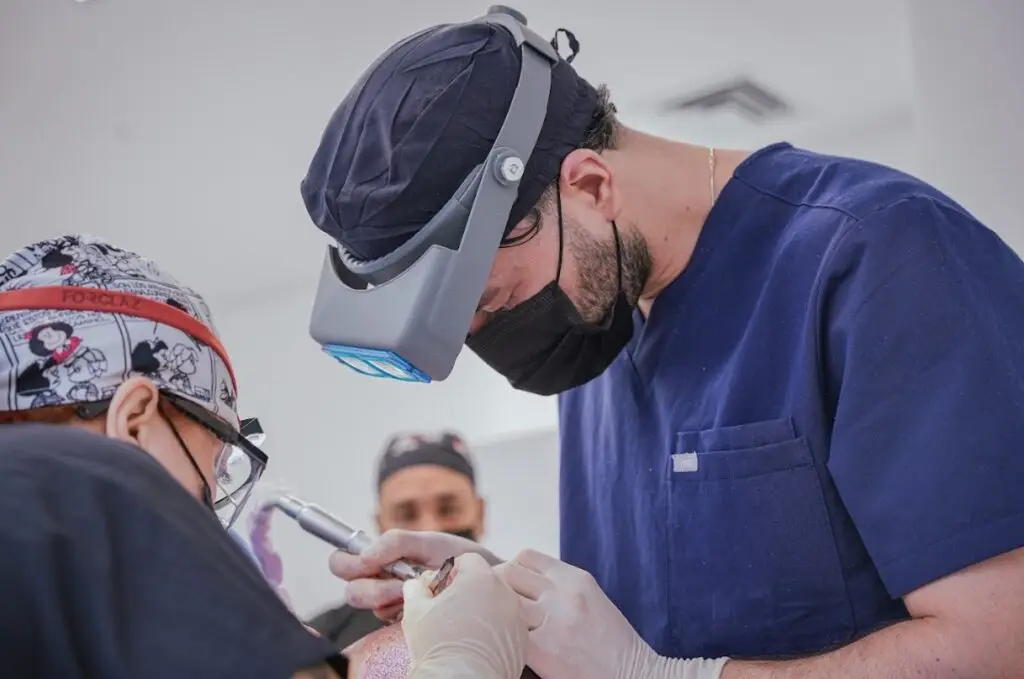
Once the medical plan is defined, the hair implant process during surgery is carried out with precision and control. The procedure involves the careful extraction of individual hair follicles from the donor area and their strategic implantation into the recipient zones. Each follicle is handled delicately to preserve its viability and ensure optimal growth.
Our focus throughout the procedure is safety, accuracy, and natural design. By respecting the natural angle, direction, and depth of each implanted follicle, we achieve results that blend seamlessly with existing hair. At the same time, advanced techniques and meticulous execution allow us to significantly reduce trauma to the scalp, helping to minimize hair implant scars and support a smoother recovery.
Hair transplant men vs hair implant women: key differences in approach
Although the medical foundation of the procedure is the same, the aesthetic strategy varies between hair transplant men and hair implant women. In men, hairline design often prioritizes structured, age-appropriate contours, while density distribution focuses on frontal and crown restoration. In women, the approach is typically more conservative, maintaining softness along the hairline and enhancing overall volume without altering natural proportions.
These differences reflect distinct aesthetic goals by gender, and addressing them correctly is essential for achieving authentic, balanced results. By adapting each step of the hair implant process to the individual, we ensure outcomes that look natural—not only immediately, but for years to come.
Hair Implant Results and Recovery Timeline in Medellín
At Dharma Hair, we are very clear with our patients from the first consultation: hair implant results in Colombia are progressive, not immediate. Understanding this from the beginning is essential to avoid unrealistic expectations. The hair implant process follows the natural biological cycle of hair growth, which means that results evolve over time rather than appearing overnight.
From a medical perspective, results can be divided into two phases:
Short-term outcomes include:
• Mild redness or sensitivity in the treated areas
• Formation of small scabs that naturally fall off within days
• Temporary changes that are part of normal healing
Long-term outcomes focus on:
• Progressive hair growth with increasing density
• Natural integration with existing hair
• Stable, long-lasting results designed to age naturally
Hair follicles implanted during the procedure enter a resting phase before starting new growth. This biological process is not a complication—it is a sign that the scalp is responding correctly to treatment.
Hair transplant after 3 months: visible changes
One of the most discussed stages is the hair transplant after 3 months, as this is when many patients notice changes that can be confusing if not properly explained. Medically, this phase represents a transition rather than a result.
At this stage, patients typically experience:
Shedding phase (normal and temporary):
• Implanted hairs may fall out
• The scalp may look similar to pre-treatment stages
• Follicles remain active beneath the skin
Early regrowth signs:
• Fine new hairs begin to emerge
• Hair texture may appear thinner at first
• Growth is uneven as follicles activate at different times
We always emphasize that shedding does not mean failure. On the contrary, it indicates that the follicles are resetting to begin a healthy growth cycle.
Hair transplant month by month: full recovery timeline Medellín
Explaining the hair transplant month by month evolution allows patients to follow their progress with confidence and clarity. While everyone heals at a different pace, the general medical timeline is as follows:
Month 1
• Healing of donor and recipient areas
• Scabs fall off naturally
• Follicles stabilize under the scalp
Months 2–3
• Temporary shedding phase
• Minimal visible growth
Months 4–6
• Early regrowth becomes noticeable
• Hair starts to gain strength and consistency
Months 7–9
• Significant improvement in density
• Hair blends more naturally with existing strands
Months 10–12
• Final texture and thickness develop
• Mature, stable hair implant results become visible
By the end of this period, most patients achieve their definitive outcome. At Dharma Hair in Medellín, we monitor each stage closely, ensuring that recovery progresses as expected and that results reflect the personalized medical plan designed for each case.
You may be interested Hair transplant in Colombia: the complete medical tourism guide 2026
Safety, Hair transplant side effects, Scars, and Cost Considerations
From a medical standpoint, the hair transplant side effects associated with a properly performed hair implant process are generally mild, temporary, and manageable. At Dharma Hair in Colombia, patient safety is central to every stage of treatment, which is why we emphasize realistic education rather than minimizing concerns.
The most common temporary side effects include:
- Mild swelling in the treated areas
- Redness or sensitivity of the scalp
- Temporary numbness in donor or recipient zones
- Formation of small scabs that naturally resolve
These effects are part of the normal healing response and typically subside within days or weeks. Importantly, when the procedure is planned correctly and executed with precision, the risk of complications is significantly reduced. Proper follicle handling, controlled implantation depth, and strict clinical protocols are essential factors that allow us to minimize trauma and support optimal recovery.
Hair implant scars: what patients should know
One of the most frequent concerns we address is the possibility of visible hair implant scars. Modern hair restoration techniques are designed specifically to reduce or eliminate noticeable scarring, especially when compared to older surgical methods that involve large incisions or linear scars.
With contemporary approaches, follicular extraction and implantation are performed using micro-instruments that respect the natural anatomy of the scalp. As a result:
- Scars are typically minimal and difficult to detect
- Healing is faster and more uniform
- The donor area maintains a natural appearance
However, the outcome depends greatly on the expertise of the medical team and the technology used. Precise technique, correct spacing, and an individualized surgical plan are crucial to achieving clean healing and natural results. This is why choosing an experienced, specialized clinic plays a decisive role in scar management.
Hair implant how much: factors that influence cost
When patients ask hair implant how much, it is important to understand that hair restoration cannot be reduced to a fixed price without a proper medical evaluation. Each case is unique, and several factors influence the complexity and scope of the procedure.
The most relevant factors include:
- Number of grafts required to achieve natural coverage
- Technique used, based on hair characteristics and clinical goals
- Medical team and technology, which directly impact safety and results
For this reason, at Dharma Hair we always recommend a personalized consultation. A detailed assessment allows us to design an ethical, realistic treatment plan aligned with the patient’s needs and long-term expectations, ensuring that the investment reflects both medical quality and sustainable results.
Why Choose Dharma Hair in Medellín for Your Hair Implant Process?
At Dharma Hair in Medellín, our approach to the hair implant process is rooted in medical expertise, personalization, and ethical practice. We work with a patient-centered model that begins with an individual diagnosis, allowing us to design precise treatment plans for both men and women. Each case is evaluated based on hair loss pattern, scalp condition, and long-term goals, ensuring that every decision is medically justified and aesthetically coherent. This level of personalization is what allows us to achieve natural results that respect each patient’s identity rather than applying standardized solutions. Our clinic is in the Torre Médica Oviedo, a consolidated medical environment that guarantees safety, accessibility, and high clinical standards.
We combine advanced technology with precision-driven techniques to deliver consistent, safe, and predictable outcomes. Our focus is not on short-term promises, but on sustainable hair implant results supported by careful execution, strict clinical protocols, and ongoing follow-up care. From the initial consultation to post-procedure monitoring, we accompany our patients at every stage, positioning Dharma Hair as a trusted reference in modern hair restoration—where results are built on science, experience, and responsibility.
Frequently Asked Questions About the Hair Implant Process
1. What is the hair implant process and how does it work?
The hair implant process is a medically planned procedure in which healthy hair follicles are extracted from a donor area and implanted into areas affected by hair loss. At Dharma Hair, we perform this process with a personalized approach, respecting natural hair direction, density, and growth cycles. The goal is not just to restore hair, but to achieve results that look natural and remain stable over time.
2. Is the hair implant process different for women and men?
Yes, the hair implant process varies between hair implant women and hair implant man cases. Women often require a more conservative approach that preserves existing hair and enhances overall density, while men usually need structured hairline restoration and targeted coverage in frontal or crown areas. Each plan is adjusted according to gender-specific patterns and aesthetic goals.
3. Am I a good candidate for a hair implant?
Candidacy depends on several factors, including the cause of hair loss, scalp health, donor area quality, and realistic expectations. During our medical evaluation, we determine whether the hair implant process is the best option or if alternative treatments are more appropriate. A personalized diagnosis is essential to ensure safe and effective results.
4. How long does it take to see hair implant results?
Hair implant results are gradual. While healing occurs within the first few weeks, visible growth usually begins after a few months. Significant improvement is typically noticeable between six and nine months, with results appearing around twelve months after the procedure. This timeline follows the natural hair growth cycle.
5. What happens during a hair transplant after 3 months?
A hair transplant after 3 months often coincides with the shedding phase, where implanted hairs fall out temporarily. This is a normal and expected part of the process. Shortly after, early regrowth begins as follicles activate beneath the scalp, signaling that the treatment is progressing correctly.
6. What does hair transplant month by month recovery look like?
When explained hair transplant month by month, recovery typically follows a predictable pattern: healing and stabilization in the first month, shedding between months two and three, early regrowth from months four to six, and progressive density improvement from months seven to twelve. Results usually become visible by the end of the first year.
7. Are there hair transplant side effects I should be concerned about?
Most hair transplant side effects are mild and temporary. These may include redness, swelling, sensitivity, or small scabs in treated areas. When the procedure is performed using proper medical technique and advanced technology, risks are minimized and recovery is generally smooth.
8. Will I have visible hair implant scars?
With modern techniques, visible hair implant scars are uncommon. Micro-extraction and precise implantation methods significantly reduce scarring, especially when performed by an experienced medical team. Proper planning and execution are key factors in achieving clean, natural healing.
9. How much does Hair implant cost and what influences the price?
When patients ask hair implant how much, the answer depends on individual factors such as the number of grafts needed, the technique used, and the level of medical expertise involved. Because every case is different, a personalized consultation is necessary to design an ethical and accurate treatment plan.
10. Why choose Dharma Hair for the hair implant process?
Dharma Hair combines medical expertise, advanced technology, and ethical standards to deliver reliable, natural-looking hair implant results. Our clinic, located in the Torre Médica Oviedo, offers a secure medical environment where each patient receives individualized care, long-term follow-up, and transparent guidance throughout the entire hair implant process.